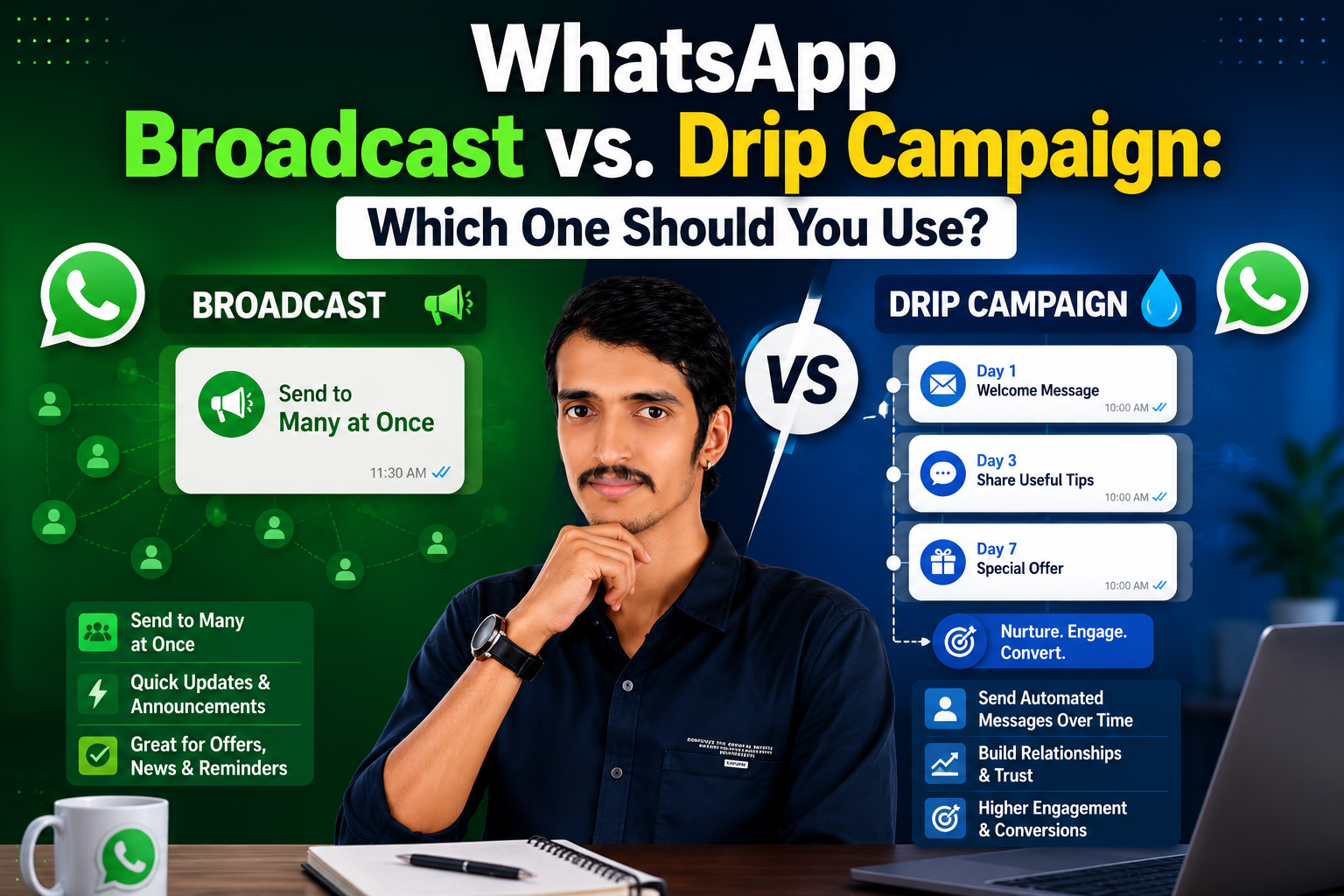
Quick answer: A WhatsApp broadcast sends one message to many contacts at the same moment — best for announcements and sales. A WhatsApp drip campaign sends a timed sequence of messages triggered by what an individual customer does — best for nurturing leads, recovering carts, and onboarding. The strongest strategies use both together: a broadcast opens the conversation, a drip campaign carries it forward for anyone who doesn’t immediately act.
What Is a WhatsApp Broadcast?
A broadcast delivers the same message to a list of contacts at once, with each person receiving it as a private, one-to-one chat — not a group thread. No one sees who else got the message or what anyone else replied.
It’s the WhatsApp equivalent of an email blast: one message, one send, reaching everyone on the list simultaneously.
When to Use a Broadcast
Reach for a broadcast when you have one update meant for many people at the same time, with no need for automated follow-up:
- Announcing a new product or feature
- Flash sales or seasonal promotions
- Event invitations or single reminders
- General notifications that apply to your whole list
Tip: Segment your list before sending (by purchase history, interest, or lifecycle stage) so the message actually feels relevant. Relevant broadcasts get read; irrelevant ones get muted — and repeated mutes can hurt your account’s quality rating over time.
What Is a WhatsApp Drip Campaign?
A drip campaign is a series of automated messages released over time, based on something a specific customer did (or didn’t do). Instead of one message ending the interaction, the conversation continues on a schedule — a reminder here, a nudge there — until the customer responds, converts, or the sequence runs out.
If a customer replies or completes the target action mid-sequence, the campaign stops automatically, so no one gets messages they no longer need.
When to Use a Drip Campaign
Choose a drip campaign whenever a single message isn’t enough to move someone to a decision:
- Recovering an abandoned cart
- Nurturing a new lead after an inquiry
- Following up after a demo or proposal
- Onboarding a new customer or user
- Re-engaging a dormant account
- Reminding someone about an upcoming appointment or event in stages
Suggested Timing by Scenario
| Scenario | First Message | Typical Gap Between Messages |
|---|---|---|
| Cart abandonment | Within 30 minutes | 6–12 hours |
| Lead nurture | Within 1 hour | 24–48 hours |
| Re-engagement | Day 1 | 3–5 days |
| Demo/proposal follow-up | Within 24 hours | 2–3 days |
| Onboarding | Immediately | 24 hours |
The goal isn’t more messages — it’s better-timed ones. A tightly sequenced three-message flow usually outperforms a longer, looser one.
Broadcast vs. Drip Campaign: Side-by-Side Comparison
| Factor | Broadcast | Drip Campaign |
|---|---|---|
| Message count | One | Typically 2–5, spaced over time |
| Timing | Sent once, manually or scheduled | Automatic, triggered by behavior |
| Personalization | Same message to everyone | Varies per message (name, product, status) |
| Role in customer journey | Opens the conversation | Advances the conversation toward a decision |
| Stops when | The single send completes | Customer replies, converts, or the sequence ends |
| Best measured by | Delivery and read rates | Reply rate and conversion rate |
| Best suited to | Announcements, promotions, updates | Nurturing, recovery, onboarding, retention |
| Typical template spend | One template per contact | Multiple templates across the sequence |
The real distinction isn’t the number of messages — it’s what happens after the first one. A broadcast is finished once it’s delivered. A drip campaign keeps adapting based on what the customer does next.
The Combination Most Businesses Overlook
The two aren’t competing options — they work best layered. A broadcast opens the door for a large audience; a drip campaign follows up individually with the people who didn’t walk through it right away.
Example: A 3-Day Sale
| When | What Goes Out | Format |
|---|---|---|
| Day 0, morning | Sale announcement to the full list | Broadcast |
| Day 1 (no response) | “Ends tomorrow” reminder | Drip, auto-triggered |
| Day 2, evening (no response) | Final-hours nudge | Drip, auto-triggered |
| Any point | Sequence stops the moment someone replies | Auto-stop on reply |
This layout gets more conversions out of a single send without over-messaging anyone who’s already engaged — the follow-ups only go to people who stayed quiet.
Quick Decision Guide
| Goal | Best Fit |
|---|---|
| Product launch | Broadcast |
| Seasonal or holiday sale | Broadcast |
| Lead nurturing | Drip campaign |
| Cart recovery | Drip campaign |
| Customer or user onboarding | Drip campaign |
| Single webinar reminder | Broadcast |
| Multi-stage webinar reminders | Drip campaign |
| Re-engaging inactive customers | Broadcast → Drip campaign |
| Flash sale with urgency follow-up | Broadcast → Drip campaign |
Common Mistakes to Avoid
- Skipping segmentation. A message that fits everyone usually resonates with no one. Group contacts by behavior, purchase history, or lifecycle stage before sending either type.
- Messaging without proper opt-in. Explicit consent isn’t optional — it protects deliverability and your account’s standing.
- Sending too frequently. Whether it’s broadcasts or drips, message fatigue leads straight to opt-outs.
- Not tracking performance. Delivery, read, reply, and conversion rates tell you what to keep and what to cut.
- Treating every message the same. Personalize where it counts — name, product, order status — rather than sending identical copy to everyone.
- Never testing. Your first version of a campaign is rarely your best one; iterate on copy, timing, and audience.
Frequently Asked Questions
What’s the core difference between a WhatsApp broadcast and a drip campaign? A broadcast sends one message to many people at once. A drip campaign sends a timed series of messages to an individual, shaped by what that person does or doesn’t do after the first message.
Is a broadcast the same as a group message? No. A broadcast delivers to each recipient privately — no one sees anyone else’s replies. A group message shares one thread where everyone can see all responses. For marketing, broadcasts protect recipient privacy far better than groups.
Do drip campaigns require the WhatsApp Business API? Yes. The standard WhatsApp Business app can’t run automated, triggered follow-up sequences — that capability requires API access through a business messaging platform, along with documented opt-in from every contact.
Which works better for lead nurturing? Drip campaigns, generally, because they follow up automatically over time rather than relying on a single touchpoint to move a lead forward.
Can I run both from the same tool? Most WhatsApp Business API platforms support both broadcast sending and drip automation from a single dashboard, so you don’t need separate tools to run each type of campaign.
This guide is provided for general informational purposes. WhatsApp’s messaging policies and template rules are updated periodically — confirm current requirements directly with Meta before launching a campaign.