
How to simplify your brand message, attract the right audience, and increase conversions using storytelling
In an era where customers scroll fast, skip ads, and ignore complex brand messages, one thing still grabs attention: a clear story.
This is why the SB7 StoryBrand Framework has become one of the most powerful tools for businesses, content creators, agencies, and entrepreneurs.
Whether you're running ads, building a landing page, writing email campaigns, or crafting social content, SB7 helps your customers understand exactly how you can change their life.
This blog explains the SB7 framework in the simplest possible way — even non-marketing readers can grasp it instantly.
What Is the SB7 StoryBrand Framework?
The StoryBrand Framework (known as SB7) is a seven-part storytelling formula developed by Donald Miller.
It is built on a simple rule:
"Your customer is the hero. Your business is the guide."
Most brands make the mistake of positioning themselves as the hero.
SB7 flips the script by placing the customer at the center of the story.
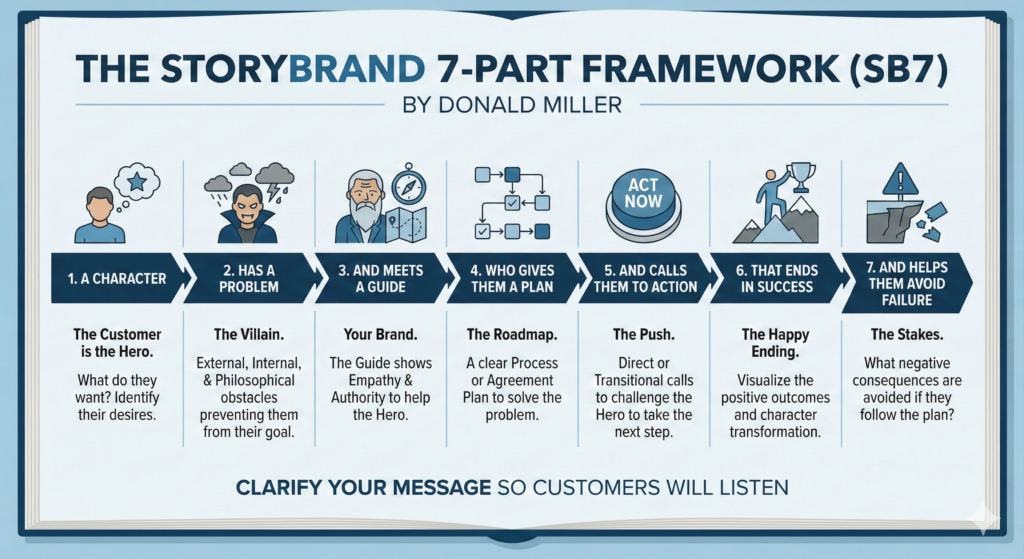
Why SB7 Works (in Simple Words)
Because people don’t buy the best product.
They buy the product they understand the fastest.
SB7 removes confusion and helps you communicate with clarity so customers think:
“This is exactly what I need.”
The 7 Parts of the SB7 Framework (Explained with General Examples)
1. The Character — The Customer With a Goal
Every story begins with someone who wants something.
In SB7, that someone is your customer.
Examples:
- A restaurant owner wants more table bookings.
- A fitness beginner wants to lose weight without confusion.
- A freelance designer wants high-paying clients.
If you don’t clearly state what your customer wants, they stop listening.
2. The Problem — The Obstacle That Stops Them
Customers buy solutions to problems.
SB7 highlights three types of problems:
- External problem:
Something physical or practical
Example: “I don’t get enough customers.” - Internal problem:
How the problem makes them feel
Example: “I’m frustrated and overwhelmed.” - Philosophical problem:
Why this shouldn’t be happening
Example: “Good products deserve more sales.”
When you state the problem clearly, your customer feels understood.
3. The Guide — You Become the Trusted Expert
Every hero meets a guide who helps them win.
In SB7, your brand must show:
- Empathy: “I understand your challenges.”
- Authority: “I have helped thousands like you.”
This step builds trust instantly.
Examples:
- A career coach saying “I’ve helped 500+ students land jobs.”
- A software brand showcasing reviews and success stories.
Guides don’t shout. They reassure.
4. The Plan — A Simple Path to Follow
Customers don’t buy when they feel confused.
Your job: make the next steps extremely simple.
Two types of plans work best:
- Process plan: 3–4 steps to follow
- Agreement plan: What guarantees trust and safety
Example process plan:
- Book a demo
- Get personalized setup
- Watch your sales grow
When customers see a clear path, they feel confident to act.
5. The Call to Action — The Clear, Direct Push
People rarely act without a direct invitation.
SB7 encourages two types of CTAs:
- Primary CTA: “Buy Now”, “Sign Up”, “Book Demo”, “Start Trial”
- Secondary CTA: “Learn More”, “Download Guide”, “Watch Video”
The clearer your CTA, the higher your conversions.
6. The Success — The Transformation They Desire
Show customers how their life will look after choosing you.
Examples:
- “Your business runs smoothly.”
- “Your leads increase without effort.”
- “Your fitness journey becomes simple.”
- “You save hours every week.”
People don’t buy features.
They buy the future version of themselves.
7. The Failure — What They Avoid
A subtle reminder of what happens if they take no action.
Examples:
- Missed opportunities
- Lost income
- More stress
- Continued confusion
Fear should not be exaggerated, but gently highlighted.
This creates urgency and clarity.
A Simple SB7 Formula You Can Copy Today
A customer (hero) has a problem.
They meet a guide (your brand) who gives them a plan
and calls them to action.
This helps them avoid failure and achieve success.
This formula works for:
- Meta ads
- Landing pages
- Email funnels
- Website homepages
- Pitch decks
- Sales videos
- WhatsApp broadcasts
- YouTube scripts
- Reels & Shorts
It is universal.
General Example Using SB7 (Easy to Understand)
Let’s imagine a local fitness coach.
1. Character:
A busy professional wants to get fit.
2. Problem:
They tried many diets but feel confused and guilty.
3. Guide:
The coach understands their struggle and has 200+ transformations.
4. Plan:
- Book consultation
- Get personalized plan
- Follow daily 10-minute routine
5. CTA:
“Join the 30-day challenge.”
6. Success:
More energy, weight loss, confidence.
7. Failure:
Unhealthy lifestyle continues.
This simplicity is why SB7 is so effective.
Benefits of Using SB7 for Your Business
- Clear brand message
- Higher conversions
- Stronger engagement
- Faster content creation
- Better ad performance
- More storytelling power
SB7 turns complex messaging into a simple, powerful narrative.
Conclusion: SB7 = Clarity + Storytelling + Conversions
If you want your brand to stand out, get remembered, and convert, the SB7 StoryBrand Framework will transform the way you communicate.
Simple message + clear story = more customers who take action.